1950's Rochelle Furniture Mfg. Baby Time Furniture Swinging Baby Cradle

Various methods of transporting children have been used in dissimilar cultures and times. These methods include babe carriages (prams in British English), infant car seats, portable bassinets (carrycots), strollers (pushchairs), slings, backpacks, baskets and bicycle carriers.
The large, heavy prams (short for perambulator), which had get popular during the Victorian era, were replaced by lighter designs during the latter half of the 1900s.
Baskets, slings and backpacks [edit]

A travois being used to transport infants
Infant carrying likely emerged early in human evolution as the emergence of bipedalism would have necessitated some ways of carrying babies who could no longer cling to their mothers and/or simply sit down on top of their mother's back.[ane] On-the-torso carriers are designed in various forms such as baby sling, haversack carriers, and soft front or hip carriers, with varying materials and degrees of rigidity, ornament, support and confinement of the child. Slings, soft forepart carriers, and "infant carriages" are typically used for infants who lack the ability to sit or to concur their caput up. Frame backpack carriers (a modification of the frame haversack), hip carriers, slings, mei tais and a variety of other soft carriers are used for older children.


An ergonomic carrier worn on the dorsum
Images of children beingness carried in slings can be seen in Egyptian artwork dating back to the time of the Pharaohs,[2] and have been used in many ethnic cultures. Ane of the earliest European artworks showing babe wearing is a fresco by Giotto painted in effectually 1306 AD, which depicts Mary conveying Jesus in a sling.[three] Baby wearing in a sling was well known in Europe in medieval times, only was mainly seen as a practise of marginalised groups such as beggers and gypsies.[4] A cradleboard is a Native American baby carrier used to keep babies secure and comfortable and at the same time allowing the mothers freedom to work and travel.[5] The cradleboards were attached to the female parent'southward back straps from the shoulder or the head. For travel, cradleboards could exist hung on a saddle or travois. Ethnographic tradition indicates that information technology was mutual practice to cradleboard newborn children until they were able to walk,[6] although many mothers continued to swaddle their children well past the outset birthday. Leap and wrapped on a cradleboard, a baby tin can experience safe and secure. Soft materials such as lichens, moss and shredded bark were used for cushioning and diapers. Cradleboards were either cut from flat pieces of wood or woven from flexible twigs like willow and hazel, and cushioned with soft, absorbent materials. The design of well-nigh cradleboards is a flat surface with the kid wrapped tightly to it. It is unremarkably but able to movement its head.
On-the-torso baby carrying started being known in western countries in the 1960s, with the advent of the structured soft pack in the mid-1960s. Around the same time, the frame backpack apace became a popular way to comport older babies and toddlers. In the early 1970s, the wrap was reintroduced in Germany. The 2 ringed sling was invented by Rayner and Fonda Garner in 1981 and popularized by Dr William Sears starting in around 1985.[7] In the early 1990s, the modernistic pouch carrier was created in Hawaii. While the Chinese mei tai has been around in one form or another for centuries, it did not go popular in the west until it was modernized with padding and other adjustments. Information technology first became popular and well known in mid-2003.
Portable cradles, including cradleboards, baskets, and bassinets, have been used by many cultures to carry young infants.
Wheeled transport methods [edit]
Wheeled devices are more often than not divided into prams, used for newborn babies in which the infant unremarkably lies down facing the pusher, and the strollers, which are used for the pocket-sized child up to most three years old in a sitting position facing forward.
History [edit]
William Kent developed an early on stroller in 1733.[8] In 1733, the Duke of Devonshire asked Kent to build a means of send that would carry his children. Kent obliged by constructing a shell shaped basket on wheels that the children could sit down in. This was richly decorated and meant to be pulled by a goat or small pony. Benjamin Potter Crandall sold baby carriages in the US in the 1830s which have been described as the "offset baby carriages manufactured in the US"[9] Another early development was F.A. Whitney Carriage Company. His son, Jesse Armour Crandall was issued a number of patents for improvements and additions to the standard models. These included calculation a restriction to carriages, a model which folded, designs for parasols and an umbrella hanger. By 1840, the babe wagon became extremely popular. Queen Victoria bought three carriages from Hitchings Baby Store.
The carriages of those days were congenital of wood or wicker and held together past expensive brass joints. These sometimes became heavily ornamented works of art. Models were also named later on royalty: Princess and Duchess beingness pop names, as well as Balmoral and Windsor.
In June 1889, an African American human being named William H. Richardson patented his thought of the starting time reversible stroller. The bassinet was designed then it could confront out or in towards the parent. He also fabricated structural changes to the carriage. Until so the beam did not allow each cycle to motility separately. Richardson's design immune this, which increased maneuverability of the carriages. As the 1920s began, prams were now available to all families and were becoming safer, with larger wheels, brakes, deeper prams, and lower, sturdier frames.
In 1965, Owen Maclaren, an aeronautical engineer, worked on complaints his girl fabricated nearly travelling from England to America with her heavy pram. Using his knowledge of aeroplanes, Maclaren designed a stroller with an aluminium frame and created the beginning true umbrella stroller. He so went on to institute Maclaren, which manufactured and sold his new blueprint. The design took off and soon "strollers" were easier to transport and used everywhere.
In the 1970s, even so, the trend was more towards a more basic version, not fully sprung, and with a detachable trunk known as a "carrycot".[notes i] At present, prams are very rarely used, being big and expensive when compared with "buggies" (see below). I of the longer lived and improve known brands in the UK is Silver Cross, showtime manufactured in Hunslet, Leeds, in 1877, and later Guiseley from 1936 until 2002 when the mill closed. Argent Cantankerous was then bought by the toy company David Halsall and Sons who relocated the caput office to Skipton and expanded into a range of new, modern baby products including pushchairs and "travel systems". They continue to sell the traditional Silvery Cross omnibus prams which are manufactured at a factory in Bingley in Yorkshire.
Since the 1980s, the stroller industry has developed with new features, safer construction and more accessories.
Prams [edit]

Larger and heavier prams, or perambulators had been used since their introduction in the Victorian era; prams were also used for infants, ofttimes sitting upward. The term carrycot became more common in the UK after the introduction of lighter units with detachable baby carriers in the 1970s.
Equally they developed through the years suspension was added, making the ride smoother for both the babe and the person pushing it.
A pram was histically called Perambulator.
Strollers [edit]

A kid existence pushed in a stroller
'Strollers' or 'pushchairs/buggies' (British English), are used for minor children upward to virtually three years old in a sitting position facing forward.
"Pushchair" was the popularly used term in the UK between its invention and the early on 1980s[ citation needed ], when a more compact design known as a "buggy" became the trend, popularised past the conveniently collapsible aluminium-framed Maclaren buggy designed and patented by the British aeronautical designer Owen Maclaren in 1965. "Buggy" is the usual term in the Uk (sometimes "pushchair"); in American English language, buggy usually refers to a four-wheeled vehicle known as a quad or quad bike in the UK. "Stroller" is the usual term in the USA. Newer versions tin can be configured to carry a baby lying down like a low pram and so be reconfigured to conduct the kid in the frontward-facing position.
A variety of twin pushchairs are manufactured, some designed for babies of a similar age (such equally twins) and some for those with a pocket-sized age gap. Triple pushchairs are a fairly contempo addition, due to the number of multiple births being on the increase. Condom guidelines for standard pushchairs apply. Most triple buggies take a weight limit of 50 kg and recommended utilize for children up to the age of 4 years.
A travel system is typically a set consisting of a chassis with a detachable baby seat and/or carrycot. Thus a travel system can be switched betwixt a pushchair and a pram. Some other benefit of a travel system is that the detached chassis (mostly an umbrella endmost chassis) when folded volition ordinarily be smaller than other types, to ship information technology in a automobile trunk or boot. Also, the baby seat will snap into a base meant to stay in an motorcar, condign a car seat. This allows undisturbed movement of the baby into or out of a car and a reduced gamble of waking a sleeping infant.
Another mod pattern showcases a stroller that includes the possibility for the lower trunk to be elongated, thereby transforming the stroller into a kick scooter. Steering occurs past leaning towards either side. Depending on the model, it can be equipped with a foot- and/or handbrake. Speeds upwards to 15 km/h (ten mph) can be reached. The starting time stroller of this kind was the then-called "Roller Buggy", adult by industrial designer Valentin Vodev in 2005. In 2012 the manufacturer Quinny became interested in the concept and teamed up with a Belgian studio to design another model.
The modernistic infant car seat is a relative latecomer. It is used to carry a child within a car. Such car seats are required past police in many countries to safely transport immature children.
Others [edit]
Bicycles can be fitted with a bicycle trailer or a children's bicycle seat to carry small children. An older child can ride on a one-cycle trailer wheel with an integrated seat and handle bars.
A "travel system" includes a car seat base, an babe automobile seat, and a infant stroller. The motorcar seat base is installed in a car. The infant car seat snaps into the car seat base when traveling with a baby. From the machine, the infant auto seat tin can be hand carried and snapped onto the stroller.
Gallery [edit]
-

An 1847 stroller from the John Leech Athenaeum
-
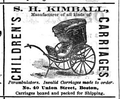
An advertisement for an early perambulator in the 1868 Boston Directory
-

Baby carriages for sale in Stockholm, Sweden in 1931.
-

A baby in a buggy, USA, 1935
-
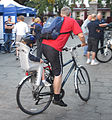
A kid in a bicycle carrier
-

A car seat for infants
-

A 3-in-1 travel organisation
-

A baby sitting in a stroller with a doll above her caput
-

A baby in a stroller with belts holding her in identify
-
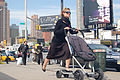
A roller buggy, 2005
-

A perambulator
-
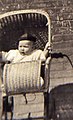
Wicker baby buggy from 1908
Come across also [edit]
- Infant sling
- Baby walker
- Babywearing
- Doll pram
- Shopping cart
- Travel cot
Notes [edit]
- ^ The modern equivalent—for babies that cannot walk—is a pram with a body that tin can be detached for carrying or for attaching to a frame to become a car seat (a "travel system").
References [edit]
- ^ Wall-Scheffler, C.Yard.; Geiger, M.; Steudel-Numbers, M. (2007). "Infant conveying: The part of increased locomotory costs in early development". American Journal of Physical Anthropology. 133 (2): 841–846. doi:10.1002/ajpa.20603. PMID 17427923.
- ^ I.C. van Hout. Beloved Burden - Baby wearing effectually the earth. pp 6-seven. Purple Tropical Plant, Amsterdam. 2011. ISBN 9789068321746
- ^ Rosie Knowles. Why Babywearing Matters. p 19. Pinter & Martin, 2016. ISBN 9781780665351
- ^ I.C. van Hout. Honey Burden - Infant wearing around the globe. pp 58-63. Purple Tropical Institute, Amsterdam. 2011. ISBN 9789068321746
- ^ Cradleboard Encarta. Retrieved 27 March 2009. Archived 2009-10-31.
- ^ [one], Native American Cradles exhibited at Pequot Museum, The 24-hour interval - October 6, 2001, Retrieved 4 May 2015.
- ^ Maria Blois MD. Babywearing - The Benefits and Beauty of This Ancient Tradition. pp 32-35. Hale Publishing, 2005. ISBN 0972958339
- ^ Amato, Joseph (November 2004). On pes: a history of walking - Google Book Search. ISBN9780814705025 . Retrieved 2009-03-24 .
- ^ .Museum of American Heritage, retrieved vi Sep 2010
Bibliography [edit]
- van Hout, I.C. (1993). Honey Burdens. Koninklijk Instituut voor de Tropen.
- Fontanel, Beatrice (Oct ane, 1998). Babies Celebrated. Harry N Abrams. ISBN0-8109-4012-four.
External links [edit]
- Bushwalkers' pram (1930s) at the National Museum of Australia.
Source: https://en.wikipedia.org/wiki/Baby_transport
0 Response to "1950's Rochelle Furniture Mfg. Baby Time Furniture Swinging Baby Cradle"
Post a Comment